THANKS, BOSS!

THANKS, BOSS!

THANKS, BOSS!

Bernard Arnault, LVMH and the Fine Art of Knowing Nothing

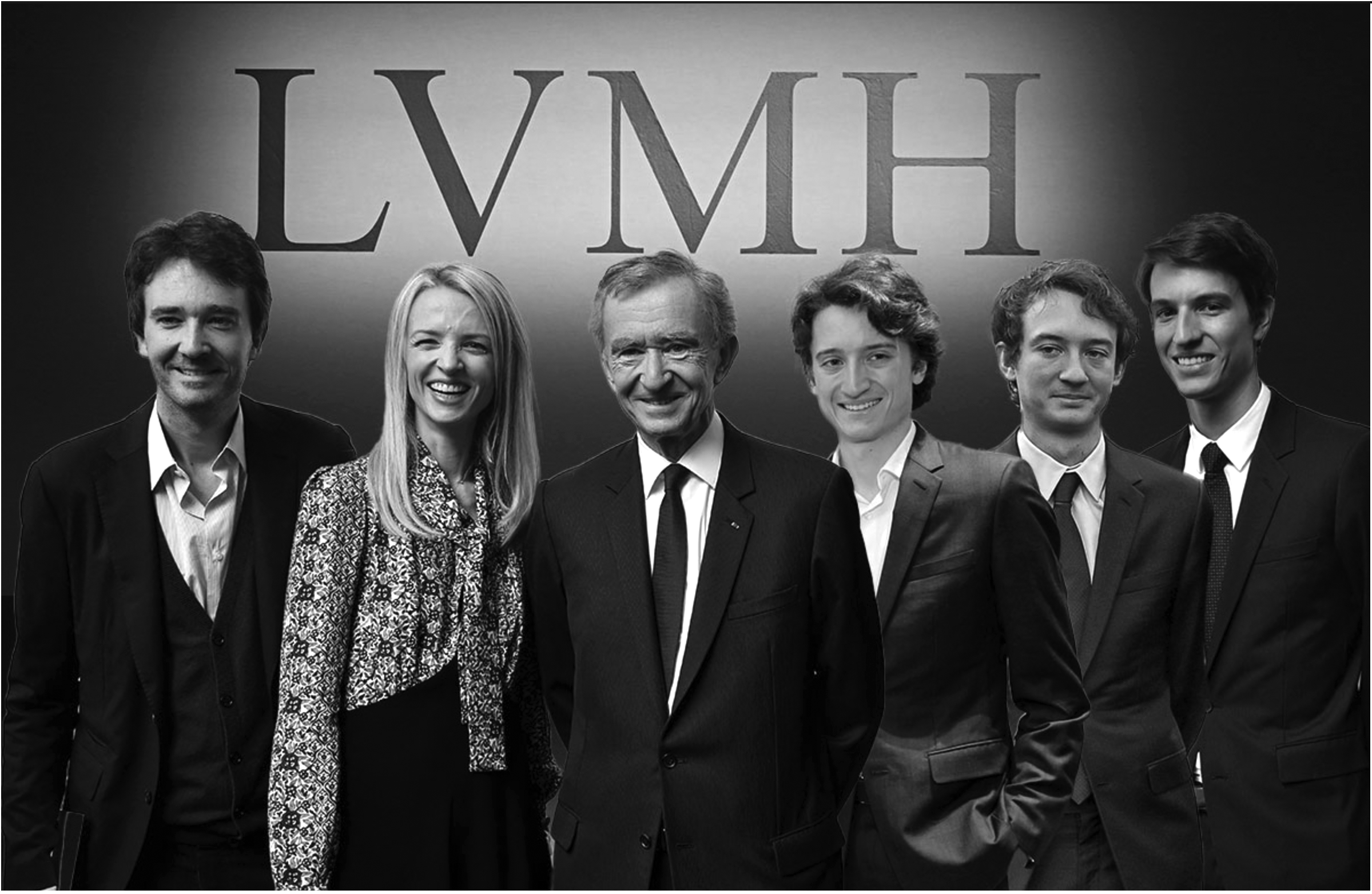
Bernard Arnault is the man behind Louis Vuitton, Dior, Tiffany & Co. and dozens of other luxury brands whose names are considerably more familiar than his own—a useful arrangement for someone whose business involves making everybody else conspicuous. As chairman and chief executive of LVMH, the French luxury conglomerate, he presides over an empire selling everything from handbags to champagne, supplying both the evidence that you have arrived and something to drink when you get there.

A Small Return on Investment

In Merci Patron!, François Ruffin approaches this titan of cultivated aspiration with the enthusiasm of a man determined to appreciate his betters. There are dividends to celebrate, a clothes dryer bought with the proceeds, and a perfectly sincere mission to reconcile the billionaire with the people whose livelihoods have rather inconveniently disappeared along his route to greatness.

It is a touching ambition. France has spent centuries trying to reconcile the people with their rulers, with mixed results for the rulers’ necks. Ruffin brings a camera.

His 2016 documentary centres on Jocelyne and Serge Klur, former workers at a supplier making Kenzo clothing, whose jobs vanished when production moved abroad. Their predicament supplies the human scale missing from the usual Arnault profile: two people struggling to keep their home while the man at the summit of the commercial ecosystem becomes an international monument to success.

The film’s title translates as Thanks, Boss! Gratitude, delivered with sufficient conviction, can become a devastating form of criticism.

Saving the Valuable Parts

Arnault’s ascent through luxury began with the distressed Boussac empire, acquired in 1984 with the support of France’s Socialist authorities. Among its industrial problems sat a particularly attractive asset: Christian Dior.

Musk can keep the crown; Bernard has the champagne, the maisons and the Paris addresses. If your fortune must fluctuate, it might as well do so in excellent taste.

Musk can keep the crown; Bernard has the champagne, the maisons and the Paris addresses. If your fortune must fluctuate, it might as well do so in excellent taste.

Arnault spoke of limiting the damage to employment. Thousands of jobs subsequently disappeared as businesses were reorganised and sold. Dior survived to become a cornerstone of his fortune.

A difficult rescue, certainly. Though from the workers’ perspective, the distinction between being rescued and being removed from the balance sheet may have required clarification.

Here was a template for the coming age: the value of an enterprise could be liberated from the people who depended on it. The brand retained its history; the employees acquired one.

Today, luxury sells heritage with extraordinary tenderness. Every stitch has ancestors. Every trunk remembers a voyage. An old workshop can sustain several paragraphs of reverence, provided its history concludes with something expensive still available to buy.

The history of a closed factory is harder to merchandise.

Seventy-Five Ways to Be Unique

LVMH presents its maisons as distinctive creative worlds, united by exceptional craftsmanship. Its decentralised structure is real: the houses have their own identities, teams and considerable operational autonomy. Above them sits the power of a common owner, allocating capital and assembling an extraordinary portfolio of desirable names.

This is Arnault’s achievement. He understood how to organise the commercial exploitation of uniqueness on an industrial scale.

There is real talent inside that machine: designers, leatherworkers, perfumers, jewellers. Their skill gives the promise substance. The financial genius lies in making their work carry an additional charge for belonging, recognition and the possibility of being mistaken for someone with a better life.

A handbag becomes a small, portable answer to a large social question: where do I stand?

When status feels insecure, the answer can become very expensive.

Which makes luxury an unusually elegant participant in an unequal economy. It sells visible distance from insecurity to people who may still be living quite close to it.

The queue outside the boutique and the anxiety about next month’s bills can belong to the same person.

Made in Italy, Priced in Heaven

In 2024, the distance between luxury’s promise and its production became awkwardly measurable. Italian investigators examining Dior’s supply chain described exploitative conditions at subcontractors. Court documents cited a €53 payment for assembling a bag sold in shops for €2,600.

Those figures deserve precision. The €53 was a subcontracting charge, excluding materials and the wider costs of design, distribution and retail; it was never a calculation of Dior’s net profit. Dior said the suppliers performed partial assembly, rejected misleading claims about its margins and cut ties with them.

Even after the accounting is corrected, a question remains: what ethical assurance has the customer actually purchased?

Five children, one empire, and the remarkable discovery that the best candidates were already on the Christmas card. Equal opportunity begins at home.

Five children, one empire, and the remarkable discovery that the best candidates were already on the Christmas card. Equal opportunity begins at home.

The luxury premium comes wrapped in stories about care. It invites us to believe that exceptional attention travels all the way through the object. Discovering that attention may become less exceptional at the workshop door rather spoils the unboxing.

The Italian subsidiary was placed under court administration. That oversight ended early in February 2025 after the court approved stronger controls. A separate consumer-protection investigation closed in May with binding commitments and no finding of infringement.

Credit where it is due: improvements followed.

It is simply encouraging to discover that an industry capable of tracing a creative inspiration to an eighteenth-century garden can, with judicial assistance, also trace its subcontractors.

The Security Department Enjoyed the Film

Ruffin’s documentary attracted another kind of attention.

In March 2025, former French intelligence chief Bernard Squarcini was convicted of offences including using public resources to benefit LVMH and complicity in the illegal surveillance of Ruffin and his newspaper, Fakir. His lawyers announced an appeal.

LVMH had already paid €10 million in 2021 to settle the related criminal investigation. The agreement entailed no admission of guilt or criminal conviction of the company. Arnault appeared at Squarcini’s trial as a witness, denied knowing about the surveillance and was not a defendant.

We should receive that denial with the respect due to sworn testimony.

We may also contemplate the organisational mystery. The public story of LVMH celebrates a leader of exceptional strategic command. The surveillance story introduces a more distant figure, unaware of activities undertaken for the group’s benefit.

An empire can apparently be sufficiently coherent to express one man’s vision and sufficiently dispersed to leave him uninformed about some of its methods.

This is the fine art of knowing nothing: a problem of corporate accountability that survives regardless of what any individual can be proved to have known.

For a company selling dreams, the interest in a filmmaker was nevertheless rather intense. Ruffin had managed to produce the one form of attention luxury rarely commissions.

The News Comes Beautifully Wrapped

Fortunately, criticism can also be encountered through more conventional channels.

LVMH’s expanding media holdings include Les Échos, Le Parisien, L’Opinion, L’Agefi and Challenges. Journalists’ unions and Reporters Without Borders have challenged the concentration of ownership and demanded stronger protections for independence; Challenges journalists went on strike in April 2026.

One should avoid the lazy suggestion that every journalist takes instructions from an owner. The structural problem is more durable: a major subject of economic reporting acquires increasing power over the institutions doing the reporting.

Rupert Murdoch built his influence through a media empire whose politics rarely require decoding. Arnault’s power begins somewhere more seductive: taste, aspiration and the authority to decide what a successful life should look like. By adding economic newspapers to his collection, the man selling that vision increasingly owns the places where its benefits are explained and its costs debated. Murdoch’s influence comes with an editorial line; Arnault’s comes wrapped in cashmere and calls itself savoir-faire.

Advertising supplies another instrument. In 2012, LVMH advertising was withdrawn from Libération after its insulting front page about Arnault’s Belgian citizenship application.

Editorial freedom may remain intact while the advertising budget exercises its own freedom to leave.

For readers, the difficulty is knowing how much pressure ever needs to become an explicit instruction. Ownership and commercial dependence can establish the atmosphere long before anyone edits a sentence.

Even the air conditioning has a proprietor.

Please Tighten Your Belts

Outside this carefully managed atmosphere, France has been demonstrating.

On October 24, the Interior Ministry counted 410,000 protesters nationwide; the CGT estimated nearly 800,000. A movement that began over school staffing and funding has widened into anger about living costs and inequality. Clashes and arrests have accompanied the demonstrations.

Those grievances bring Arnault’s world into sharper focus. A country capable of producing extraordinary private fortunes finds itself arguing about the resources required to educate its children.

The protesters have their varied demands and politics. Arnault did not personally create every fiscal problem in France. But his position in the argument is revealing.

In September 2025, he attacked Gabriel Zucman’s proposed minimum wealth tax targeting fortunes above €100 million, presenting it as a danger to the French economy.

The proposal’s supporters saw a question of contribution. Arnault saw a threat to prosperity. It is a familiar dispute over who may be asked to sacrifice, and who must first be reassured.

This summer supplied a particularly French complication: an administrative court ruling assessing Arnault and his wife roughly €22.5 million in additional taxes and related charges. The dispute concerns the tax treatment of money received from a Belgian holding company; his representative said he would appeal.

A tax dispute is no criminal conviction. It does, however, add texture to a national conversation about whose finances require discipline.

LVMH pays substantial taxes and employs many people; its economic contribution is real. That contribution deserves recognition. It also brings us to an extraordinary modern expectation: gratitude for successful enterprise should apparently settle the terms on which its owners participate in society.

Thanks, Boss! begins to sound less like a film title and more like a proposed social contract.

Neoliberalism, With Complimentary Gift Wrapping

The economist Richard J. Murphy, in the video that prompted this wider reflection, describes the French conflict as a confrontation between the demands of financial capital and ordinary people’s needs.

His announcement of neoliberalism’s demise may be premature. Systems organised around powerful interests are remarkably good at surviving their own obituaries.

But his underlying question belongs here: what is the economy being asked to accomplish, and for whom?

Arnault makes an unusually vivid figure through whom to examine it. His empire depends on culture, skilled labor, public institutions, and a stable society. Its rewards accumulate through ownership. Meanwhile, the cost of maintaining the shared foundations of prosperity becomes an argument about what the country can afford.

The state remains useful as a provider of infrastructure, protection and cultural prestige. Its requests for a larger contribution encounter a more demanding review process.

Luxury adds its own twist. Inequality supplies both the fortunes at the top and the desire to display proximity to them. The consumer buys a symbol of arrival; the owner collects a return on the journey.

This does not make the customer foolish. The wish for beauty, pleasure or recognition is human. The commercial accomplishment is teaching people to express those wishes through objects whose prices advertise the distance between them.

The bag holds your belongings. The business model holds your aspirations.

Five Outstanding Candidates

Happily, the future of this meritocracy has received careful consideration.

All five of Arnault’s children hold senior roles within the group. Their preparation has included monthly working lunches with their father. In July 2026, Arnault dismissed reports of bitter family rivalry and insisted that the family remained united.

We should wish them well. Family lunches are difficult enough without a luxury empire between the bread and the butter.

Their competence can be assessed on its merits. The opportunity to demonstrate it has, however, been distributed with impressive biological consistency.

Luxury calls this continuity. Elsewhere, young people are invited to call their insecurity a challenge and improve their personal brand.

Both generations are preparing for the future. Only one has been allowed to acquire it in advance.

Merci, Patron

Ruffin’s film ends with a victory. By making their story a potential embarrassment for LVMH, the Klurs obtain compensation and a job for Serge.

The comedy works because the people are never the joke. Their need is ordinary; the machinery they must activate to have it recognised is absurd.

They have to become a reputational problem before they become a solvable human one.

That is what connects their dining room to the streets of France today. People are asking how to make their needs count in a system exquisitely responsive to the protection of wealth and considerably harder to impress with hardship.

Arnault’s defenders can point to brands preserved, jobs created, taxes paid and beauty brought into the world. Those achievements belong in the picture. So do the workers, the suppliers and the public institutions on which the picture depends.

The problem begins when the gratitude is expected to travel in only one direction.

Thanks, Boss.

We were hoping for a society. The gift wrapping is lovely.

The Suits Ate Fashion. Now the Robots Get Dessert.

The Suits Ate Fashion. Now the Robots Get Dessert.

The Suits Ate Fashion. Now the Robots Get Dessert.

Fashion is currently having one of its periodic nervous breakdowns about artificial intelligence. Designers will disappear. Algorithms will decide what we wear. TikTok will identify a microtrend at breakfast, artificial intelligence will design it before lunch, and somewhere outside Guangzhou a factory will have 40,000 units ready before anyone has worked out whether we actually wanted the thing.

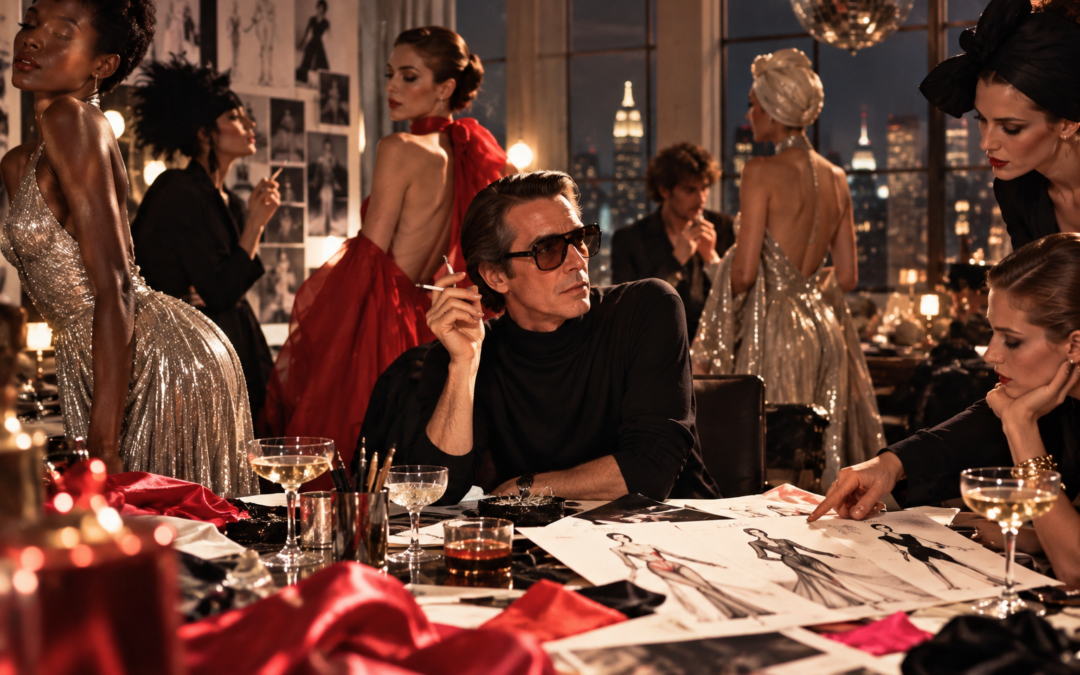
Creativity before the spreadsheet: Halston turned late nights, beautiful people, bad habits and instinct into fashion people actually wanted.

Creativity before the spreadsheet: Halston turned late nights, beautiful people, bad habits and instinct into fashion people actually wanted.

The anxiety is understandable. It is also slightly late.

Long before generative AI learned how to make a handbag with seven handles and an inexplicable third zipper, fashion had already begun removing the troublesome human ingredients from its business model: intuition, eccentricity, patience, experimentation, obsession and, worst of all, people with opinions.

AI did not invent fashion slop.

It arrived after several decades of excellent preparatory work.

First, Remove the People Who Care

There was a time when fashion companies were built around people who were frankly inconvenient.

Yves Saint Laurent thought fashion belonged somewhere in the vicinity of art. Halston went to Studio 54, stayed out until indecent hours, then wandered into the studio and somehow translated the whole nocturnal circus into clothes. Karl Lagerfeld treated it as an expression of the present and appeared constitutionally incapable of being bored.

None of this would survive a contemporary efficiency review.

Imagine presenting Halston to a private-equity operating partner. His hours are irregular. His personal brand creates key-person risk. His creative process cannot be entered into Excel. Studio 54 appears to be producing no measurable return on investment whatsoever.

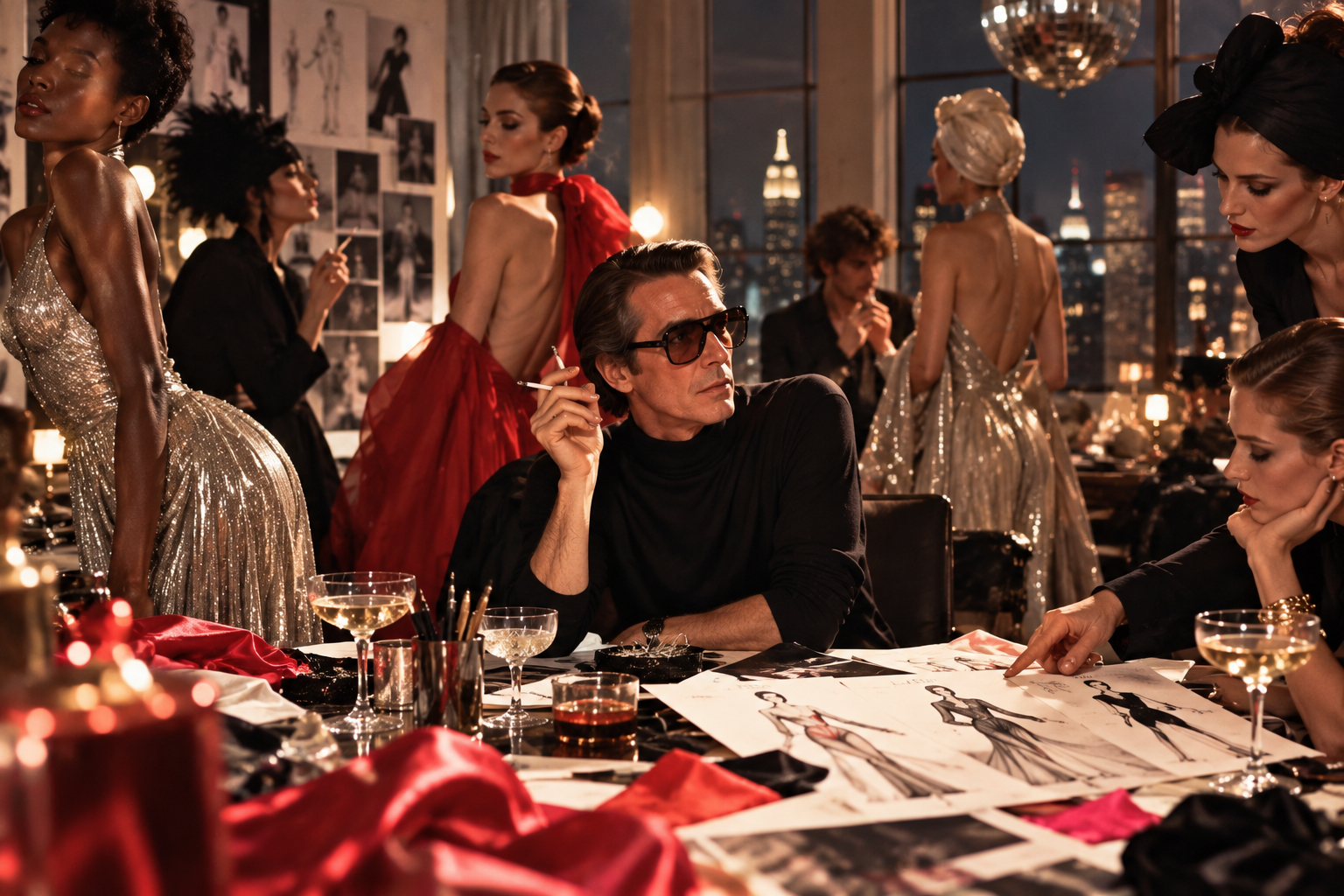
Creativity after the spreadsheet: immaculate tailoring, excellent lighting, twelve very well-dressed people, and a quarterly meeting to determine whether instinct meets projected margins.

Creativity after the spreadsheet: immaculate tailoring, excellent lighting, twelve very well-dressed people, and a quarterly meeting to determine whether instinct meets projected margins.

The modern corporation prefers a different kind of genius: predictable, scalable, measurable and ideally available as a software subscription.

Fashion's gradual corporatization did not eliminate creativity, of course. Wonderful designers still work inside enormous companies. But the balance of power changed. The designer increasingly became one component inside a machine whose real language was no longer silhouette, proportion, fabric or desire. It was growth, margin, inventory turns, customer acquisition, conversion and exit multiple.

Then private equity arrived with an especially seductive proposition: what if we made capitalism even more capitalist?

Private equity is often described as sophisticated finance. Sometimes it is. It can provide capital, restructure failing businesses, professionalize operations and help companies grow. Even the Bank of England acknowledges its role in providing long-term capital to British businesses.

But there is another version, the one fashion knows rather well: buy something somebody else built, load it with expectations and frequently debt, extract efficiencies, improve the numbers, and eventually sell it to somebody else.

It is entrepreneurship with the awkward entrepreneurial bit removed.

The Lazy Genius of Financial Engineering

This is where neoliberalism performed one of its better magic tricks.

For decades, we were told that markets would make companies more efficient. Often they did. Unfortunately, nobody specified what they were supposed to become efficient at.

Making better products is difficult. Building a culture is difficult. Training craftspeople takes years. Creating something nobody knew they wanted is horribly unreliable. Maintaining factories, investing in employees, developing materials and allowing designers to make mistakes all involve money disappearing today in the vague hope that something worthwhile might happen tomorrow.

Financial engineering is much tidier.

The private-equity model did not create short-term capitalism, but it perfected one particularly elegant version of it: treat the company itself as an asset whose financial performance can be optimized during an ownership window.

Suddenly the brand has another customer.

Not the woman buying the coat.

The next owner buying the company.

That distinction changes everything.

The transcript that prompted this article points to EVERLANE, a company built around "radical transparency" and conscious consumption, which later took investment from L Catterton and eventually landed at SHEIN after accumulating substantial debt. Whatever one thinks of the individual companies involved, the trajectory contains a wonderful piece of contemporary poetry: a brand whose identity was transparency ending up inside the empire most associated with hyper-fast, algorithmically driven fashion.

You couldn't workshop a better metaphor.

Britain, Incorporated

If you want to see what happens when financialization becomes a national hobby, look at Britain.

Britain spent several decades enthusiastically selling, outsourcing, privatizing, securitizing and generally discovering that almost anything becomes more exciting once somebody puts it into a holding company.

Water. Railways. Care homes. Veterinary practices. Supermarkets. Infrastructure. Housing. Essential services acquired the intoxicating glamour of the spreadsheet.

Private equity is now deeply embedded in the British economy. The Bank of England estimates that PE-backed companies account for roughly 10 percent of UK private-sector employment and around 15 percent of corporate debt. It also points to significant leverage and is actively stress-testing the private-markets ecosystem.

That does not mean private equity "caused" Britain's economic problems. Britain's famous inability to build things, invest enough, maintain infrastructure, resolve planning constraints or think beyond the next political weather system has many parents. The Bank of England notes that UK capital investment has remained low relative to other G7 economies for years.

But private equity belongs beautifully to the same cultural moment.

It represents an economy increasingly brilliant at owning things and strangely less interested in making them.

Which brings us neatly back to fashion.

Then the Algorithm Discovered Taste

Once fashion had been converted from a cultural business into an increasingly optimized consumer-products business, the algorithm did not need to stage a coup.

The throne was vacant.

Companies had already learned to watch what sold, measure what clicked, copy what moved and eliminate what couldn't justify itself quickly enough. Social media then provided the missing ingredient: a gigantic real-time laboratory containing billions of people voluntarily broadcasting what they desired.

Why employ somebody to imagine what people might want next year when TikTok can tell you what 19-year-olds wanted seventeen minutes ago?

The fashion company becomes less creator than seismograph.

The transcript describes Addicted as explicitly more algorithm-based than design-based, using search behavior, social-media trends and celebrity outfits to determine assortments before rapidly producing hundreds of inexpensive styles.

This sounds technologically advanced until you notice that the machine is essentially looking backward at enormous speed.

That is the central joke of algorithmic fashion. It presents itself as futuristic while being structurally nostalgic. It can only identify what has already generated a signal. Yesterday's novelty becomes today's data point, tomorrow's product and Thursday's landfill.

AI makes this spectacularly efficient.

It can generate more designs, more imagery, more variations, more descriptions, more campaigns and eventually more synthetic influencers wearing more synthetic clothes in synthetic Tuscan villas.

Infinite content meets infinite product.

At last, supply can become as bored as demand.

AI Slop Is a Business Model

We tend to discuss AI slop as an aesthetic problem: ugly images, generic prose, derivative music, soulless clothes.

That misses the more interesting point.

Slop is an economic achievement.

It is what happens when a system becomes extraordinarily good at producing adequate things cheaply, quickly and continuously while becoming progressively worse at explaining why those things should exist.

Private equity and generative AI therefore make oddly compatible bedfellows. One asks: how can we extract more measurable value from an existing asset? The other asks: how can we generate more plausible output from existing material?

Neither question is inherently evil. Both can produce useful results.

But neither is the question from which culture normally begins.

Culture asks something much more financially irritating: What if we tried this?

There may be no data. There may be no demonstrated demand. The customer may initially hate it. The board may not understand it. The first collection may fail.

This is how genuinely new things tend to enter the world: without a five-year revenue history.

AI doesn't destroy that possibility. Private equity doesn't automatically destroy it either. But an economic culture obsessed with optimization gradually makes such irrational behavior harder to defend.

And creativity is gloriously inefficient.

The Future Needs Worse Businesspeople

Perhaps fashion's next revolution will not be technological at all.

Perhaps it will involve rediscovering the value of people who are slightly bad at optimization.

Designers who make something because they cannot stop thinking about it. Founders who refuse to sell. Companies willing to remain small. Manufacturers who keep expensive skills alive. Customers who buy fewer things and keep them long enough to develop an emotional relationship with a stain.

People, in other words, behaving irrationally.

Because the great irony of algorithmic capitalism is that everyone is desperately searching for differentiation while using increasingly identical systems to find it.

The same trend reports. The same consumer data. The same platforms. The same consultants. The same AI models trained on the same cultural archive, producing variations informed by the same engagement signals, presented to consumers through the same recommendation engines.

And then everyone holds a strategy meeting to discuss why nothing feels distinctive anymore.

Fashion does not have an AI problem so much as it has an imagination-accounting problem.

We spent decades teaching businesses that anything difficult to measure was suspicious. Private equity accelerated the lesson. Algorithms automated it. Artificial intelligence may now industrialize it.

So perhaps we have the chronology backward.

The robots did not arrive and turn fashion into a spreadsheet.

Fashion turned itself into a spreadsheet.

The robots simply learned how to dress for the office.

TOO LUXURIOUS TO LIVE

TOO LUXURIOUS TO LIVE

TOO LUXURIOUS TO LIVE

Luxury spent decades manufacturing scarcity. Sometimes the final production step was destroying what it had already made. Now the law is asking an unexpectedly philosophical question: if a perfectly good Chanel bag already exists, who gets to decide that it shouldn’t?

The Bag, the Thief and the Shredder

Some crimes are against fashion; others involve fashion.

Four former Chanel warehouse employees in Hong Kong recently received prison sentences ranging from four to seven years for stealing hundreds of Chanel handbags and wallets. The schemes dated back to 2016 and 2017, and the goods were worth millions of Hong Kong dollars.

So far, nothing particularly philosophical. People stole expensive handbags. People got caught. People went to prison. Crime, punishment, quilted calfskin.

Except for one exquisite detail. Chanel didn’t want the bags. They were waiting to be destroyed.
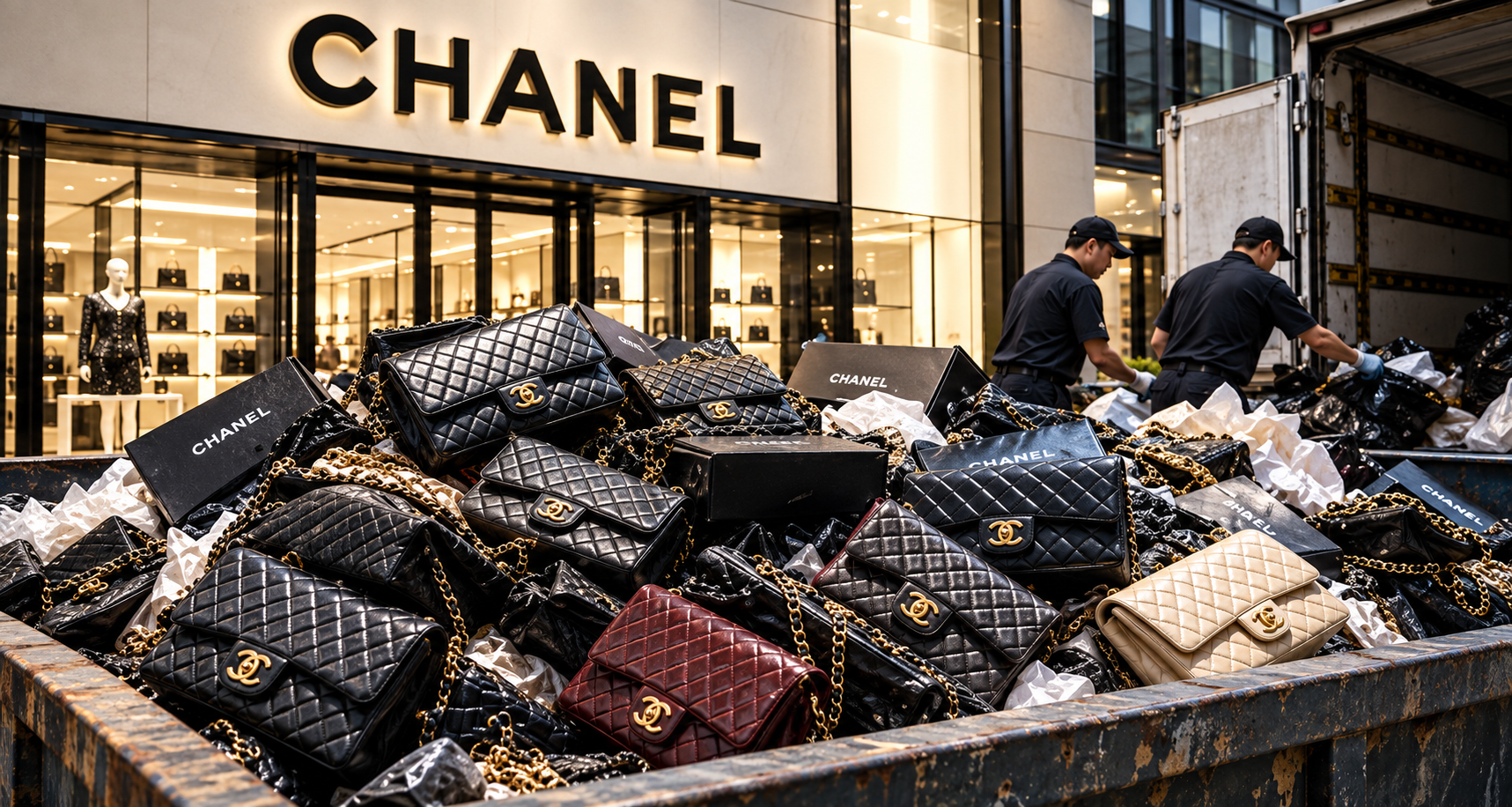
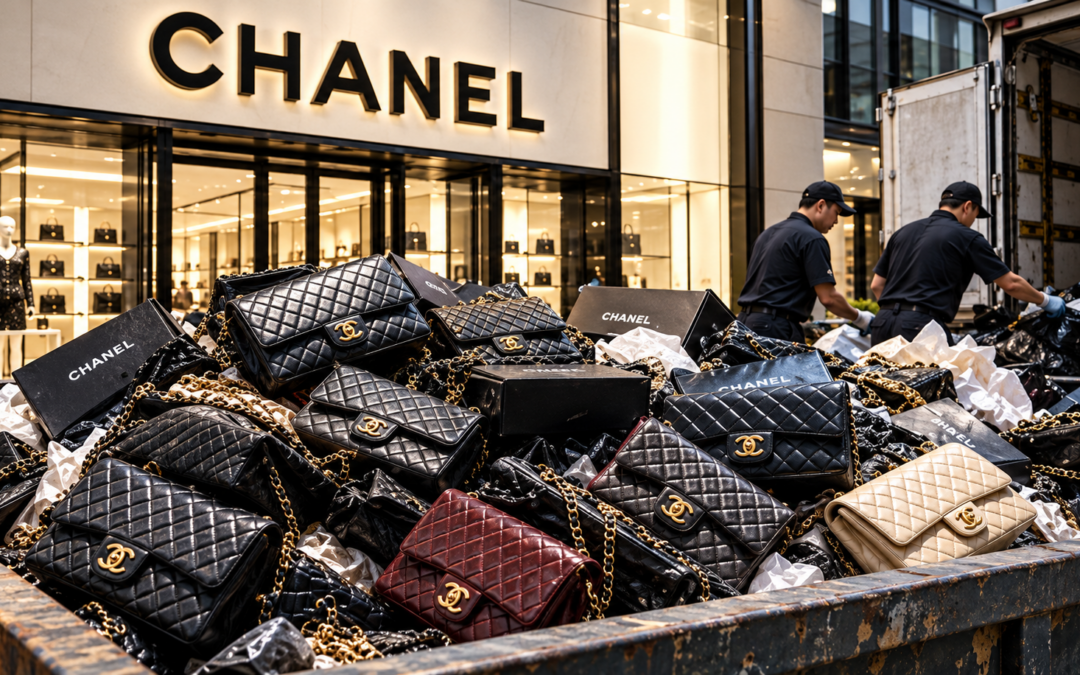
Millions in luxury, headed for the shredder. Steal them and suddenly they’re valuable again.

Millions in luxury, headed for the shredder. Steal them and suddenly they’re valuable again.

According to evidence presented during the proceedings, Chanel Hong Kong had historically been destroying somewhere between 10,000 and 20,000 outdated luxury items approximately every six months. The unwanted merchandise was unpacked and mechanically shredded.

The thieves apparently had another recycling proposal.

They intended to sell it.

This was illegal, of course. Stealing remains stealing even when the victim is standing beside a shredder. The employees weren’t environmental activists staging an intervention for endangered handbags. They wanted money.

But ethically, economically and philosophically, something magnificent happens the moment they remove the condemned bags from the warehouse.

The bags become valuable again.

THE MIRACULOUS RESURRECTION OF VALUE

Consider the journey of one hypothetical Chanel bag.

It begins life as an expensive luxury object. Leather is selected, hardware attached, craftsmanship applied, branding added, marketing performed. It enters the world carrying a retail price capable of financing a respectable holiday.

Then nobody buys it.

Eventually Chanel decides it is obsolete.

For practical purposes, its commercial value becomes zero. Worse than zero, actually. The bag has become a liability. Allow it into the wrong market at the wrong price and it might interfere with the carefully maintained value of all the Chanel bags successfully sold at the right price.

So the bag is sentenced to death.

Then somebody steals it.

Suddenly everybody remembers that it is valuable.

Police become involved. Lawyers become involved. Courts become involved. Retail valuations appear. Prison sentences follow.

The object that was too worthless to sell has become too valuable to steal.

And after the authorities recovered the goods?

They were reportedly destroyed.

Order restored.

There is something almost reassuring about the consistency.

SCARCITY, NOW AVAILABLE IN INDUSTRIAL QUANTITIES

Luxury has always depended partly on scarcity. There is nothing inherently sinister about that.

A master craftsperson can make only so many objects. Rare materials are rare. Complicated things take time. A small atelier cannot produce ten million handbags simply because quarterly earnings would find the experience invigorating.

That is organic scarcity.

Modern luxury discovered something more ambitious.

Massive global corporations wanted scarcity and growth simultaneously.

This presents a small mathematical inconvenience.

If you need to sell more things every year, you generally need to make more things. If you make more things, there are more things. If there are more things, the things become less scarce.

Luxury’s solution was ingenious.

Make more things, then carefully control where all those things are allowed to exist.

Scarcity became an administrative achievement.

Waiting lists, allocations, controlled distribution, discreet outlet strategies, hostility toward grey markets, aggressive trademark protection and, historically, when necessary, destruction all helped maintain the illusion that abundance had somehow remained exclusive.

The shredder wasn’t the failure of the luxury system.

The shredder was part of the system.

It was marketing’s basement.

BURBERRY DISCOVERS FIRE

Chanel was hardly alone.

In 2018, Burberry became the poster child for luxury destruction after revealing that it had destroyed £28.6 million worth of finished goods during the previous financial year.

The public reacted with the curious belief that manufacturing perfectly good products and then destroying them might be wasteful.

Burberry subsequently announced that it would stop destroying unsaleable finished products.

Progress.

Richemont, owner of Cartier and other prestigious watch houses, faced a slightly different version of the same problem. During a period of excess inventory, the group bought back hundreds of millions of euros worth of watches from retailers, partly to prevent them appearing on the grey market at discounts. Many were dismantled and their components recycled.

Again, the problem wasn’t necessarily that the products had become physically defective.

The problem was that they might become cheap.

And a cheap authentic luxury product can be considerably more dangerous to a luxury company than a destroyed luxury product.

A counterfeit says: I want what you make.

A discounted authentic product says: Perhaps what you make isn’t worth what you said.

No wonder one requires lawyers and the other occasionally required machinery.

THE LOGO SURVIVES THE BAG

What exactly is being protected when a perfectly functional luxury product is destroyed?

Not the leather. The leather is about to have an unfortunate afternoon.

Not the craftsmanship. That disappears with it.

Not the utility of the object. Nobody doubts that the handbag remains capable of the technologically demanding task of carrying things.

What survives is the abstraction.

CHANEL.

The physical Chanel bag can be sacrificed to preserve the metaphysical Chanel.

That may be the purest expression of modern luxury economics imaginable. The object exists to support the symbol until its existence threatens the symbol, at which point the object must go.

Oscar Wilde would surely have appreciated the arrangement. We have finally created a society in which appearances are not merely more important than reality. Reality can be mechanically shredded when it becomes inconvenient to appearances.

THE EUROPEAN UNION ENTERS THE WAREHOUSE

Unfortunately for the shredder, regulators have arrived.

Under the European Union’s Ecodesign for Sustainable Products Regulation, large companies have been prohibited since July 19, 2026 from destroying certain categories of unsold apparel, clothing accessories and footwear, subject to specified exemptions. Medium-sized companies are scheduled to follow later.

The legislation contains a surprisingly interesting idea.

Recycling isn’t necessarily good enough.

For years, corporate sustainability has trained us to hear the word recycling and applaud before asking what actually happened.

But consider the handbag again.

It is finished. It works. It is already a handbag.

Recycling a perfectly good handbag because you produced too many handbags is an extraordinarily complicated way of avoiding the simpler conclusion that perhaps you produced too many handbags.

Grinding an object back into materials isn’t circularity’s greatest triumph when the circle could simply have remained a bag.

PLEASE DO NOT RESCUE THE HANDBAG

None of this absolves the thieves. They were stealing for profit, not liberating political prisoners from a Chanel warehouse.

But remove intention for a moment and the physical sequence becomes wonderfully strange.

One party possesses a perfectly functional object and intends to destroy it. Another removes the object and intends to return it to commercial use.

The second party has committed the crime.

The first has protected the brand.

Property law makes this perfectly understandable. Environmental ethics makes it considerably less comfortable.

The leather didn’t simply “come from somewhere.” An animal died. Its skin was processed, dyed, cut and stitched into a handbag. Metal was mined and manufactured. Water and energy were consumed. People made the bag, transported it, stored it and marketed it. Land, carbon, labor, materials and, in the case of leather, animal life have already been transformed into an object.

Whatever one thinks about using animals for leather, destroying the finished object adds a particularly grotesque final flourish: the animal died for something deliberately manufactured, only for the manufacturer to decide that the object itself must now die too.

All that extraction, life, labor and energy, not because the bag failed, but because it failed to sell at the desired price.

At that point, the shredder isn’t merely destroying inventory.

It is destroying everything that went into making the inventory.

Can ownership morally include the unlimited right to erase all of that embodied value merely to maintain the price of other objects?

Legally, historically, often yes.

Ethically?

Welcome to luxury.

THE SECONDHAND HERESY

There is another reason this story matters now.

Resale has destroyed the fantasy that luxury brands completely control the lives of their products.

A handbag once had a relatively straightforward commercial biography: brand, boutique, customer. The brand controlled the first two stages and then politely stopped looking.

Now the bag may travel through five owners, three countries, two resale platforms and an authentication center before appearing on Instagram attached to someone born after it was manufactured.

The object has acquired an afterlife.

That is economically awkward for an industry built around selling new objects, but philosophically rather wonderful.

Because resale introduces a radical proposition:

The object may have value independent of the brand’s desire to sell another object.

That sounds obvious until you realize how much of modern consumer capitalism depends upon us forgetting it.

A well-made handbag can remain a well-made handbag for decades.

Which raises an uncomfortable possibility.

Perhaps the most sustainable luxury product isn’t the recyclable one.

Perhaps it is the one that stubbornly refuses to become waste.

THE GREAT LUXURY CONTRADICTION

This is where the handbag becomes considerably larger than a handbag.

The luxury conglomerate wants growth while luxury wants scarcity. The conglomerate wants more customers while luxury wants exclusivity. The conglomerate wants increasing production while luxury wants rarity. The conglomerate wants quarterly performance while luxury wants timelessness.

Eventually those contradictions stop being marketing language and become physical inventory.

Somewhere, somebody has to reconcile the poetry with the spreadsheet.

For a while, the shredder helped.

You could manufacture abundance upstream and manufacture scarcity downstream. Produce 120, sell 100, eliminate 20 and return to the boardroom with the reassuring conviction that the world contains only 100.

Voilà.

Limited edition.

Scarcity with an eraser.

WHAT IF LUXURY TRIED LUXURY?

There is, inconveniently, another solution.

Make fewer things.

This is unlikely to electrify the investor presentation.

But imagine luxury built around genuinely limited production, made-to-order manufacturing, repair, restoration, authenticated resale, archive programs, remanufacturing and objects designed to survive several owners.

Not sustainability as penance.

Luxury as longevity.

Not producing 20,000 objects too many and then commissioning a circular-economy strategy to determine what sophisticated industrial process should happen to them.

Just don’t make the 20,000.

The irony is almost painful.

After decades of expansion, financialization and industrial scaling, environmental regulation may eventually force luxury to rediscover the characteristics that originally made something luxurious: rarity, craft, longevity, care and things worth keeping.

This would require accepting slower growth, smaller volumes and the terrifying possibility that an excellent handbag sold twenty years ago might still satisfy somebody today.

Don’t worry.

We aren’t expecting miracles.

THE RIGHT TO DESTROY

And so we return to our condemned Chanel bag.

It exists. Someone made it. Someone wants it. The company doesn’t want to sell it. Someone takes it. The law says the taking is wrong. The company destroys it.

For property law, there is little mystery. The bag belongs to Chanel. You cannot steal somebody else’s property simply because you disagree with what they intend to do with it.

But ethics is rarely considerate enough to stop where law stops.

If an object has already consumed materials, labor and environmental resources, and another human being wants to use it, does ownership confer an unlimited moral right to destroy it solely to protect the price of other objects?

And if society increasingly decides that the answer is no, something rather profound has changed.

We are no longer arguing about recycling.

We are asking whether manufactured objects acquire, through the resources embodied in them, a claim against pointless destruction.

That question travels far beyond handbags.

Luxury merely makes the absurdity easier to see because it attaches enormous monetary value to an object before deciding that the continued existence of the same object threatens its value.

Perhaps that is the final irony of the Chanel case.

The employees treated the unwanted bags as valuable and were sent to prison for it.

Chanel treated them as worthless and was protecting their value.

The bags were recovered.

The bags were destroyed.

The brand survived.

Naturally.

It was the only thing in the warehouse that was never in any danger.

TOO LUXURIOUS TO LIVE

Luxury spent decades manufacturing scarcity. Sometimes the final production step was destroying what it had already made. Now the law is asking an unexpectedly philosophical question: if a perfectly good Chanel bag already exists, who gets to decide that it shouldn’t?

The Bag, the Thief and the Shredder

Some crimes are against fashion; others involve fashion.

Four former Chanel warehouse employees in Hong Kong recently received prison sentences ranging from four to seven years for stealing hundreds of Chanel handbags and wallets. The schemes dated back to 2016 and 2017, and the goods were worth millions of Hong Kong dollars.

So far, nothing particularly philosophical. People stole expensive handbags. People got caught. People went to prison. Crime, punishment, quilted calfskin.

Except for one exquisite detail. Chanel didn’t want the bags. They were waiting to be destroyed.

According to evidence presented during the proceedings, Chanel Hong Kong had historically been destroying somewhere between 10,000 and 20,000 outdated luxury items approximately every six months. The unwanted merchandise was unpacked and mechanically shredded.

The thieves apparently had another recycling proposal.

They intended to sell it.

This was illegal, of course. Stealing remains stealing even when the victim is standing beside a shredder. The employees weren’t environmental activists staging an intervention for endangered handbags. They wanted money.

But ethically, economically and philosophically, something magnificent happens the moment they remove the condemned bags from the warehouse.

The bags become valuable again.

THE MIRACULOUS RESURRECTION OF VALUE

Consider the journey of one hypothetical Chanel bag.

It begins life as an expensive luxury object. Leather is selected, hardware attached, craftsmanship applied, branding added, marketing performed. It enters the world carrying a retail price capable of financing a respectable holiday.

Then nobody buys it.

Eventually Chanel decides it is obsolete.

For practical purposes, its commercial value becomes zero. Worse than zero, actually. The bag has become a liability. Allow it into the wrong market at the wrong price and it might interfere with the carefully maintained value of all the Chanel bags successfully sold at the right price.

So the bag is sentenced to death.

Then somebody steals it.

Suddenly everybody remembers that it is valuable.

Police become involved. Lawyers become involved. Courts become involved. Retail valuations appear. Prison sentences follow.

The object that was too worthless to sell has become too valuable to steal.

And after the authorities recovered the goods?

They were reportedly destroyed.

Order restored.

There is something almost reassuring about the consistency.

SCARCITY, NOW AVAILABLE IN INDUSTRIAL QUANTITIES

Luxury has always depended partly on scarcity. There is nothing inherently sinister about that.

A master craftsperson can make only so many objects. Rare materials are rare. Complicated things take time. A small atelier cannot produce ten million handbags simply because quarterly earnings would find the experience invigorating.

That is organic scarcity.

Modern luxury discovered something more ambitious.

Massive global corporations wanted scarcity and growth simultaneously.

This presents a small mathematical inconvenience.

If you need to sell more things every year, you generally need to make more things. If you make more things, there are more things. If there are more things, the things become less scarce.

Luxury’s solution was ingenious.

Make more things, then carefully control where all those things are allowed to exist.

Scarcity became an administrative achievement.

Waiting lists, allocations, controlled distribution, discreet outlet strategies, hostility toward grey markets, aggressive trademark protection and, historically, when necessary, destruction all helped maintain the illusion that abundance had somehow remained exclusive.

The shredder wasn’t the failure of the luxury system.

The shredder was part of the system.

It was marketing’s basement.

BURBERRY DISCOVERS FIRE

Chanel was hardly alone.

In 2018, Burberry became the poster child for luxury destruction after revealing that it had destroyed £28.6 million worth of finished goods during the previous financial year.

The public reacted with the curious belief that manufacturing perfectly good products and then destroying them might be wasteful.

Burberry subsequently announced that it would stop destroying unsaleable finished products.

Progress.

Richemont, owner of Cartier and other prestigious watch houses, faced a slightly different version of the same problem. During a period of excess inventory, the group bought back hundreds of millions of euros worth of watches from retailers, partly to prevent them appearing on the grey market at discounts. Many were dismantled and their components recycled.

Again, the problem wasn’t necessarily that the products had become physically defective.

The problem was that they might become cheap.

And a cheap authentic luxury product can be considerably more dangerous to a luxury company than a destroyed luxury product.

A counterfeit says: I want what you make.

A discounted authentic product says: Perhaps what you make isn’t worth what you said.

No wonder one requires lawyers and the other occasionally required machinery.

THE LOGO SURVIVES THE BAG

What exactly is being protected when a perfectly functional luxury product is destroyed?

Not the leather. The leather is about to have an unfortunate afternoon.

Not the craftsmanship. That disappears with it.

Not the utility of the object. Nobody doubts that the handbag remains capable of the technologically demanding task of carrying things.

What survives is the abstraction.

CHANEL.

The physical Chanel bag can be sacrificed to preserve the metaphysical Chanel.

That may be the purest expression of modern luxury economics imaginable. The object exists to support the symbol until its existence threatens the symbol, at which point the object must go.

Oscar Wilde would surely have appreciated the arrangement. We have finally created a society in which appearances are not merely more important than reality. Reality can be mechanically shredded when it becomes inconvenient to appearances.

THE EUROPEAN UNION ENTERS THE WAREHOUSE

Unfortunately for the shredder, regulators have arrived.

Under the European Union’s Ecodesign for Sustainable Products Regulation, large companies have been prohibited since July 19, 2026 from destroying certain categories of unsold apparel, clothing accessories and footwear, subject to specified exemptions. Medium-sized companies are scheduled to follow later.

The legislation contains a surprisingly interesting idea.

Recycling isn’t necessarily good enough.

For years, corporate sustainability has trained us to hear the word recycling and applaud before asking what actually happened.

But consider the handbag again.

It is finished. It works. It is already a handbag.

Recycling a perfectly good handbag because you produced too many handbags is an extraordinarily complicated way of avoiding the simpler conclusion that perhaps you produced too many handbags.

Grinding an object back into materials isn’t circularity’s greatest triumph when the circle could simply have remained a bag.

PLEASE DO NOT RESCUE THE HANDBAG

None of this absolves the thieves. They were stealing for profit, not liberating political prisoners from a Chanel warehouse.

But remove intention for a moment and the physical sequence becomes wonderfully strange.

One party possesses a perfectly functional object and intends to destroy it. Another removes the object and intends to return it to commercial use.

The second party has committed the crime.

The first has protected the brand.

Property law makes this perfectly understandable. Environmental ethics makes it considerably less comfortable.

The leather didn’t simply “come from somewhere.” An animal died. Its skin was processed, dyed, cut and stitched into a handbag. Metal was mined and manufactured. Water and energy were consumed. People made the bag, transported it, stored it and marketed it. Land, carbon, labor, materials and, in the case of leather, animal life have already been transformed into an object.

Whatever one thinks about using animals for leather, destroying the finished object adds a particularly grotesque final flourish: the animal died for something deliberately manufactured, only for the manufacturer to decide that the object itself must now die too.

All that extraction, life, labor and energy, not because the bag failed, but because it failed to sell at the desired price.

At that point, the shredder isn’t merely destroying inventory.

It is destroying everything that went into making the inventory.

Can ownership morally include the unlimited right to erase all of that embodied value merely to maintain the price of other objects?

Legally, historically, often yes.

Ethically?

Welcome to luxury.

THE SECONDHAND HERESY

There is another reason this story matters now.

Resale has destroyed the fantasy that luxury brands completely control the lives of their products.

A handbag once had a relatively straightforward commercial biography: brand, boutique, customer. The brand controlled the first two stages and then politely stopped looking.

Now the bag may travel through five owners, three countries, two resale platforms and an authentication center before appearing on Instagram attached to someone born after it was manufactured.

The object has acquired an afterlife.

That is economically awkward for an industry built around selling new objects, but philosophically rather wonderful.

Because resale introduces a radical proposition:

The object may have value independent of the brand’s desire to sell another object.

That sounds obvious until you realize how much of modern consumer capitalism depends upon us forgetting it.

A well-made handbag can remain a well-made handbag for decades.

Which raises an uncomfortable possibility.

Perhaps the most sustainable luxury product isn’t the recyclable one.

Perhaps it is the one that stubbornly refuses to become waste.

THE GREAT LUXURY CONTRADICTION

This is where the handbag becomes considerably larger than a handbag.

The luxury conglomerate wants growth while luxury wants scarcity. The conglomerate wants more customers while luxury wants exclusivity. The conglomerate wants increasing production while luxury wants rarity. The conglomerate wants quarterly performance while luxury wants timelessness.

Eventually those contradictions stop being marketing language and become physical inventory.

Somewhere, somebody has to reconcile the poetry with the spreadsheet.

For a while, the shredder helped.

You could manufacture abundance upstream and manufacture scarcity downstream. Produce 120, sell 100, eliminate 20 and return to the boardroom with the reassuring conviction that the world contains only 100.

Voilà.

Limited edition.

Scarcity with an eraser.

WHAT IF LUXURY TRIED LUXURY?

There is, inconveniently, another solution.

Make fewer things.

This is unlikely to electrify the investor presentation.

But imagine luxury built around genuinely limited production, made-to-order manufacturing, repair, restoration, authenticated resale, archive programs, remanufacturing and objects designed to survive several owners.

Not sustainability as penance.

Luxury as longevity.

Not producing 20,000 objects too many and then commissioning a circular-economy strategy to determine what sophisticated industrial process should happen to them.

Just don’t make the 20,000.

The irony is almost painful.

After decades of expansion, financialization and industrial scaling, environmental regulation may eventually force luxury to rediscover the characteristics that originally made something luxurious: rarity, craft, longevity, care and things worth keeping.

This would require accepting slower growth, smaller volumes and the terrifying possibility that an excellent handbag sold twenty years ago might still satisfy somebody today.

Don’t worry.

We aren’t expecting miracles.

THE RIGHT TO DESTROY

And so we return to our condemned Chanel bag.

It exists. Someone made it. Someone wants it. The company doesn’t want to sell it. Someone takes it. The law says the taking is wrong. The company destroys it.

For property law, there is little mystery. The bag belongs to Chanel. You cannot steal somebody else’s property simply because you disagree with what they intend to do with it.

But ethics is rarely considerate enough to stop where law stops.

If an object has already consumed materials, labor and environmental resources, and another human being wants to use it, does ownership confer an unlimited moral right to destroy it solely to protect the price of other objects?

And if society increasingly decides that the answer is no, something rather profound has changed.

We are no longer arguing about recycling.

We are asking whether manufactured objects acquire, through the resources embodied in them, a claim against pointless destruction.

That question travels far beyond handbags.

Luxury merely makes the absurdity easier to see because it attaches enormous monetary value to an object before deciding that the continued existence of the same object threatens its value.

Perhaps that is the final irony of the Chanel case.

The employees treated the unwanted bags as valuable and were sent to prison for it.

Chanel treated them as worthless and was protecting their value.

The bags were recovered.

The bags were destroyed.

The brand survived.

Naturally.

It was the only thing in the warehouse that was never in any danger.
TOO LUXURIOUS TO LIVE

Luxury spent decades manufacturing scarcity. Sometimes the final production step was destroying what it had already made. Now the law is asking an unexpectedly philosophical question: if a perfectly good Chanel bag already exists, who gets to decide that it shouldn’t?

The Bag, the Thief and the Shredder

Some crimes are against fashion; others involve fashion.

Four former Chanel warehouse employees in Hong Kong recently received prison sentences ranging from four to seven years for stealing hundreds of Chanel handbags and wallets. The schemes dated back to 2016 and 2017, and the goods were worth millions of Hong Kong dollars.

So far, nothing particularly philosophical. People stole expensive handbags. People got caught. People went to prison. Crime, punishment, quilted calfskin.

Except for one exquisite detail. Chanel didn’t want the bags. They were waiting to be destroyed.

According to evidence presented during the proceedings, Chanel Hong Kong had historically been destroying somewhere between 10,000 and 20,000 outdated luxury items approximately every six months. The unwanted merchandise was unpacked and mechanically shredded.

The thieves apparently had another recycling proposal.

They intended to sell it.

This was illegal, of course. Stealing remains stealing even when the victim is standing beside a shredder. The employees weren’t environmental activists staging an intervention for endangered handbags. They wanted money.

But ethically, economically and philosophically, something magnificent happens the moment they remove the condemned bags from the warehouse.

The bags become valuable again.

THE MIRACULOUS RESURRECTION OF VALUE

Consider the journey of one hypothetical Chanel bag.

It begins life as an expensive luxury object. Leather is selected, hardware attached, craftsmanship applied, branding added, marketing performed. It enters the world carrying a retail price capable of financing a respectable holiday.

Then nobody buys it.

Eventually Chanel decides it is obsolete.

For practical purposes, its commercial value becomes zero. Worse than zero, actually. The bag has become a liability. Allow it into the wrong market at the wrong price and it might interfere with the carefully maintained value of all the Chanel bags successfully sold at the right price.

So the bag is sentenced to death.

Then somebody steals it.

Suddenly everybody remembers that it is valuable.

Police become involved. Lawyers become involved. Courts become involved. Retail valuations appear. Prison sentences follow.

The object that was too worthless to sell has become too valuable to steal.

And after the authorities recovered the goods?

They were reportedly destroyed.

Order restored.

There is something almost reassuring about the consistency.

SCARCITY, NOW AVAILABLE IN INDUSTRIAL QUANTITIES

Luxury has always depended partly on scarcity. There is nothing inherently sinister about that.

A master craftsperson can make only so many objects. Rare materials are rare. Complicated things take time. A small atelier cannot produce ten million handbags simply because quarterly earnings would find the experience invigorating.

That is organic scarcity.

Modern luxury discovered something more ambitious.

Massive global corporations wanted scarcity and growth simultaneously.

This presents a small mathematical inconvenience.

If you need to sell more things every year, you generally need to make more things. If you make more things, there are more things. If there are more things, the things become less scarce.

Luxury’s solution was ingenious.

Make more things, then carefully control where all those things are allowed to exist.

Scarcity became an administrative achievement.

Waiting lists, allocations, controlled distribution, discreet outlet strategies, hostility toward grey markets, aggressive trademark protection and, historically, when necessary, destruction all helped maintain the illusion that abundance had somehow remained exclusive.

The shredder wasn’t the failure of the luxury system.

The shredder was part of the system.

It was marketing’s basement.

BURBERRY DISCOVERS FIRE

Chanel was hardly alone.

In 2018, Burberry became the poster child for luxury destruction after revealing that it had destroyed £28.6 million worth of finished goods during the previous financial year.

The public reacted with the curious belief that manufacturing perfectly good products and then destroying them might be wasteful.

Burberry subsequently announced that it would stop destroying unsaleable finished products.

Progress.

Richemont, owner of Cartier and other prestigious watch houses, faced a slightly different version of the same problem. During a period of excess inventory, the group bought back hundreds of millions of euros worth of watches from retailers, partly to prevent them appearing on the grey market at discounts. Many were dismantled and their components recycled.

Again, the problem wasn’t necessarily that the products had become physically defective.

The problem was that they might become cheap.

And a cheap authentic luxury product can be considerably more dangerous to a luxury company than a destroyed luxury product.

A counterfeit says: I want what you make.

A discounted authentic product says: Perhaps what you make isn’t worth what you said.

No wonder one requires lawyers and the other occasionally required machinery.

THE LOGO SURVIVES THE BAG

What exactly is being protected when a perfectly functional luxury product is destroyed?

Not the leather. The leather is about to have an unfortunate afternoon.

Not the craftsmanship. That disappears with it.

Not the utility of the object. Nobody doubts that the handbag remains capable of the technologically demanding task of carrying things.

What survives is the abstraction.

CHANEL.

The physical Chanel bag can be sacrificed to preserve the metaphysical Chanel.

That may be the purest expression of modern luxury economics imaginable. The object exists to support the symbol until its existence threatens the symbol, at which point the object must go.

Oscar Wilde would surely have appreciated the arrangement. We have finally created a society in which appearances are not merely more important than reality. Reality can be mechanically shredded when it becomes inconvenient to appearances.

THE EUROPEAN UNION ENTERS THE WAREHOUSE

Unfortunately for the shredder, regulators have arrived.

Under the European Union’s Ecodesign for Sustainable Products Regulation, large companies have been prohibited since July 19, 2026 from destroying certain categories of unsold apparel, clothing accessories and footwear, subject to specified exemptions. Medium-sized companies are scheduled to follow later.

The legislation contains a surprisingly interesting idea.

Recycling isn’t necessarily good enough.

For years, corporate sustainability has trained us to hear the word recycling and applaud before asking what actually happened.

But consider the handbag again.

It is finished. It works. It is already a handbag.

Recycling a perfectly good handbag because you produced too many handbags is an extraordinarily complicated way of avoiding the simpler conclusion that perhaps you produced too many handbags.

Grinding an object back into materials isn’t circularity’s greatest triumph when the circle could simply have remained a bag.

PLEASE DO NOT RESCUE THE HANDBAG

None of this absolves the thieves. They were stealing for profit, not liberating political prisoners from a Chanel warehouse.

But remove intention for a moment and the physical sequence becomes wonderfully strange.

One party possesses a perfectly functional object and intends to destroy it. Another removes the object and intends to return it to commercial use.

The second party has committed the crime.

The first has protected the brand.

Property law makes this perfectly understandable. Environmental ethics makes it considerably less comfortable.

The leather didn’t simply “come from somewhere.” An animal died. Its skin was processed, dyed, cut and stitched into a handbag. Metal was mined and manufactured. Water and energy were consumed. People made the bag, transported it, stored it and marketed it. Land, carbon, labor, materials and, in the case of leather, animal life have already been transformed into an object.

Whatever one thinks about using animals for leather, destroying the finished object adds a particularly grotesque final flourish: the animal died for something deliberately manufactured, only for the manufacturer to decide that the object itself must now die too.

All that extraction, life, labor and energy, not because the bag failed, but because it failed to sell at the desired price.

At that point, the shredder isn’t merely destroying inventory.

It is destroying everything that went into making the inventory.

Can ownership morally include the unlimited right to erase all of that embodied value merely to maintain the price of other objects?

Legally, historically, often yes.

Ethically?

Welcome to luxury.

THE SECONDHAND HERESY

There is another reason this story matters now.

Resale has destroyed the fantasy that luxury brands completely control the lives of their products.

A handbag once had a relatively straightforward commercial biography: brand, boutique, customer. The brand controlled the first two stages and then politely stopped looking.

Now the bag may travel through five owners, three countries, two resale platforms and an authentication center before appearing on Instagram attached to someone born after it was manufactured.

The object has acquired an afterlife.

That is economically awkward for an industry built around selling new objects, but philosophically rather wonderful.

Because resale introduces a radical proposition:

The object may have value independent of the brand’s desire to sell another object.

That sounds obvious until you realize how much of modern consumer capitalism depends upon us forgetting it.

A well-made handbag can remain a well-made handbag for decades.

Which raises an uncomfortable possibility.

Perhaps the most sustainable luxury product isn’t the recyclable one.

Perhaps it is the one that stubbornly refuses to become waste.

THE GREAT LUXURY CONTRADICTION

This is where the handbag becomes considerably larger than a handbag.

The luxury conglomerate wants growth while luxury wants scarcity. The conglomerate wants more customers while luxury wants exclusivity. The conglomerate wants increasing production while luxury wants rarity. The conglomerate wants quarterly performance while luxury wants timelessness.

Eventually those contradictions stop being marketing language and become physical inventory.

Somewhere, somebody has to reconcile the poetry with the spreadsheet.

For a while, the shredder helped.

You could manufacture abundance upstream and manufacture scarcity downstream. Produce 120, sell 100, eliminate 20 and return to the boardroom with the reassuring conviction that the world contains only 100.

Voilà.

Limited edition.

Scarcity with an eraser.

WHAT IF LUXURY TRIED LUXURY?

There is, inconveniently, another solution.

Make fewer things.

This is unlikely to electrify the investor presentation.

But imagine luxury built around genuinely limited production, made-to-order manufacturing, repair, restoration, authenticated resale, archive programs, remanufacturing and objects designed to survive several owners.

Not sustainability as penance.

Luxury as longevity.

Not producing 20,000 objects too many and then commissioning a circular-economy strategy to determine what sophisticated industrial process should happen to them.

Just don’t make the 20,000.

The irony is almost painful.

After decades of expansion, financialization and industrial scaling, environmental regulation may eventually force luxury to rediscover the characteristics that originally made something luxurious: rarity, craft, longevity, care and things worth keeping.

This would require accepting slower growth, smaller volumes and the terrifying possibility that an excellent handbag sold twenty years ago might still satisfy somebody today.

Don’t worry.

We aren’t expecting miracles.

THE RIGHT TO DESTROY

And so we return to our condemned Chanel bag.

It exists. Someone made it. Someone wants it. The company doesn’t want to sell it. Someone takes it. The law says the taking is wrong. The company destroys it.

For property law, there is little mystery. The bag belongs to Chanel. You cannot steal somebody else’s property simply because you disagree with what they intend to do with it.

But ethics is rarely considerate enough to stop where law stops.

If an object has already consumed materials, labor and environmental resources, and another human being wants to use it, does ownership confer an unlimited moral right to destroy it solely to protect the price of other objects?

And if society increasingly decides that the answer is no, something rather profound has changed.

We are no longer arguing about recycling.

We are asking whether manufactured objects acquire, through the resources embodied in them, a claim against pointless destruction.

That question travels far beyond handbags.

Luxury merely makes the absurdity easier to see because it attaches enormous monetary value to an object before deciding that the continued existence of the same object threatens its value.

Perhaps that is the final irony of the Chanel case.

The employees treated the unwanted bags as valuable and were sent to prison for it.

Chanel treated them as worthless and was protecting their value.

The bags were recovered.

The bags were destroyed.

The brand survived.

Naturally.

It was the only thing in the warehouse that was never in any danger.
EVERYTHING IS RESALE

EVERYTHING IS RESALE

EVERYTHING IS RESALE

How Luxury Forgot It Was Supposed to Be About Style

Somewhere between Paris, Wall Street and Silicon Valley, fashion quietly stopped being something we wore and became something we traded.

Nobody notices a revolution while it's happening.

They notice it years later, when something that once felt perfectly ordinary suddenly feels faintly ridiculous. One day, you realize people are discussing handbags with the vocabulary once reserved for property portfolios. They compare appreciation rates, analyze historical returns, and debate market timing. Somewhere along the way, luxury stopped asking, Do I love this? and started asking, Will it hold its value?

The RealReal. When a company needs to reassure us twice that it's real, one begins to wonder. Resale didn't invent the luxury market. It completed it.

The RealReal. When a company needs to reassure us twice that it's real, one begins to wonder. Resale didn't invent the luxury market. It completed it.


That may be the biggest transformation fashion has undergone in half a century.

Not the arrival of influencers. Not Instagram. Not artificial intelligence.

The financialization of taste.

We Used to Buy Clothes

Nobody asked your grandmother whether her CHANEL jacket would outperform the S&P 500.

Nobody bought NIKE sneakers expecting positive annual appreciation.

People bought clothes because they needed them, loved them, or simply wanted to look better on Saturday night than they had on Friday afternoon. Fashion was temporary. Joyful. Occasionally wasteful. Often irrational. But it remained stubbornly human.

Objects entered our lives, accumulated memories, and eventually left them. A handbag developed scratches, softened at the corners, and quietly became yours. Its value wasn't measured by auction houses, but by holidays, relationships, and cities it had traveled through.

Today, many luxury buyers discuss keeping the stickers on the hardware.

Keeping the receipt.

Keeping the dust bag.

Keeping the box.

Keeping the resale value.

The handbag exists in a curious state between being carried and being sold. An accessory has become inventory.

The Vintage Shop That Ate Fashion

Vintage isn't new.

Every major city had its hidden treasures. New York. Paris. London. Tokyo. Little shops run by collectors with impeccable taste and questionable bookkeeping. Places that smelled faintly of old leather, cedar wood, and forgotten decades.

They recycled fashion long before sustainability acquired its own marketing department. Yet they never controlled fashion. They lived happily on the fringes of the industry, offering discoveries rather than liquidity. Then technology did what technology always does. It didn't invent something new.

The dusty vintage boutique became a global exchange. The treasure hunt became searchable inventory. The collector became a platform. Resale stopped being a niche and quietly became infrastructure. Not because consumers suddenly fell in love with second-hand fashion. Because venture capital fell in love with second-hand inventory.

The RealReal. Vestiaire Collective. Luxury divisions inside eBay. Entire businesses emerged around one extraordinary discovery. Millions of wardrobes contained dormant capital. Fashion stopped being something you wore. It became something you held.

The Financialization of Taste

Economists have watched this happen across society.

Housing became an investment.

Art became an investment.

Wine became an investment.

Whisky became an investment.

Sneakers became an investment.

Even Pokémon cards discovered the joys of portfolio diversification.

Eventually, handbags joined the club.

Luxury brands spent decades convincing us they were selling craftsmanship, heritage, and aspiration. The market quietly changed the question. Not, is it beautiful? But what will it be worth next year? That isn't a fashion question. It's a financial one. Luxury accidentally built the perfect asset. Limited supply. Global recognition. Easy transportation. Strong liquidity. Historically appreciating values.

Gold suddenly had competition with shoulder straps.

The HERMÈS Paradox

No company mastered manufactured scarcity quite like HERMÈS.

Waiting lists became legends. Client advisors became gatekeepers. Purchase histories became passports. Entire rituals emerged around proving yourself worthy of buying a handbag. For decades, it worked brilliantly. Until the internet quietly broke the spell.

Thousands upon thousands of Birkins now sit permanently online. They aren't particularly difficult to find anymore. They are only difficult to buy directly. Scarcity didn't disappear. It migrated.

Old luxury made products scarce. New luxury makes access scarce. The ritual has become more exclusive than the object itself. Ironically, resale didn't destroy luxury.

It completed it.

Brands raised prices to create scarcity. Scarcity increased resale values. Rising resale values convinced customers they weren't consuming but investing. That belief justified even higher retail prices, attracting more investors, more speculation, and more venture capital.

The handbag stopped being the destination. It became collateral.

Authenticity Is the New Counterfeit

Luxury houses spent years warning consumers about the dangers of the secondary market. Counterfeits. Questionable provenance. Uncertain authenticity.

Then authentication became one of the industry's fastest-growing businesses. Luxury once sold certainty. Now it sells verification.

There is a delicious irony hiding in the name The RealReal. Whenever a company feels compelled to include the word real in its branding, one suspects the conversation has already drifted toward the opposite. It has the same linguistic energy as calling something Truth Social. The adjective arrives before the suspicion has even left the room.

After spending years working in China, I also learned that counterfeiting doesn't end with the product. Entire ecosystems can be replicated. Certificates. Packaging. Sales receipts. Tracking numbers. Supply chains. I once visited a factory in Dongguan while producing one of my own collections and found an entire floor manufacturing bags carrying the logo of one of Europe's most prestigious fashion houses. I asked whether they were fake. "No," came the answer. "The store has given us a license."

Whether that license belonged to the brand, a distributor, a franchise operator, or somebody's imagination almost became secondary. Authenticity itself had become something that could be manufactured.

Perhaps that is the greatest luxury paradox of all. The more valuable authenticity becomes, the more profitable imitation becomes.

Sustainability, Conveniently

Resale is frequently presented as fashion's environmental redemption story. Buy second-hand. Extend the product's life. Save the planet.

It is an appealing narrative. Reality is slightly more complicated.

Research increasingly suggests that many consumers buy more simply because they believe they can resell later. Resale lowers the psychological cost of ownership. The purchase no longer feels permanent. It feels reversible.

Consumption doesn't disappear. It accelerates.

Buying another handbag isn't automatically transformed into environmental activism simply because someone else owned it for eight months. Nor does a handbag become carbon neutral after travelling from Paris to New York, to Singapore, to London and finally California simply because someone describes it as preloved.

Apparently, emissions become sustainable when wrapped in pastel green typography.

Style, Not Status

Perhaps the strangest consequence of all this isn't economic. It's cultural.

Luxury has become increasingly democratic in ownership while simultaneously becoming increasingly aristocratic in access.

Millions of people can own a Birkin. Relatively few can still buy one the "proper" way. Ownership expanded. Membership contracted. Somewhere in all of this, style quietly slipped out the back door.

Fashion was never meant to behave like an index fund. It was supposed to surprise us, delight us, occasionally embarrass us, and, every now and then, make us look gloriously ridiculous.

The bag was never the point. The person carrying it was.

The Dupe was Inevitable

The Dupe was Inevitable

The Dupe Was Inevitable

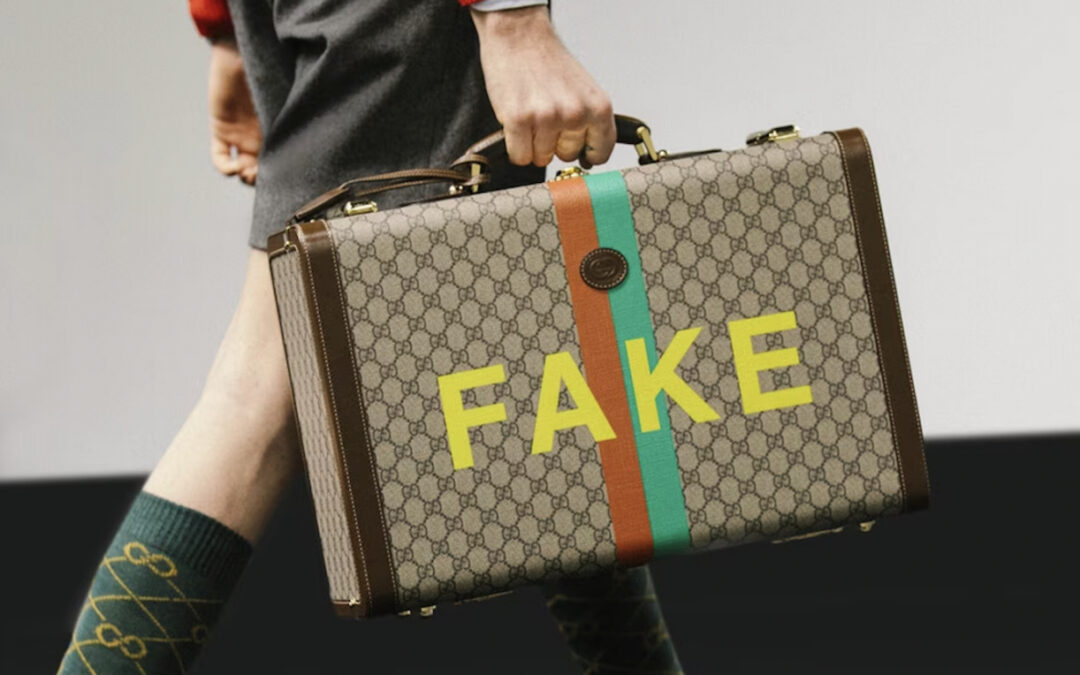
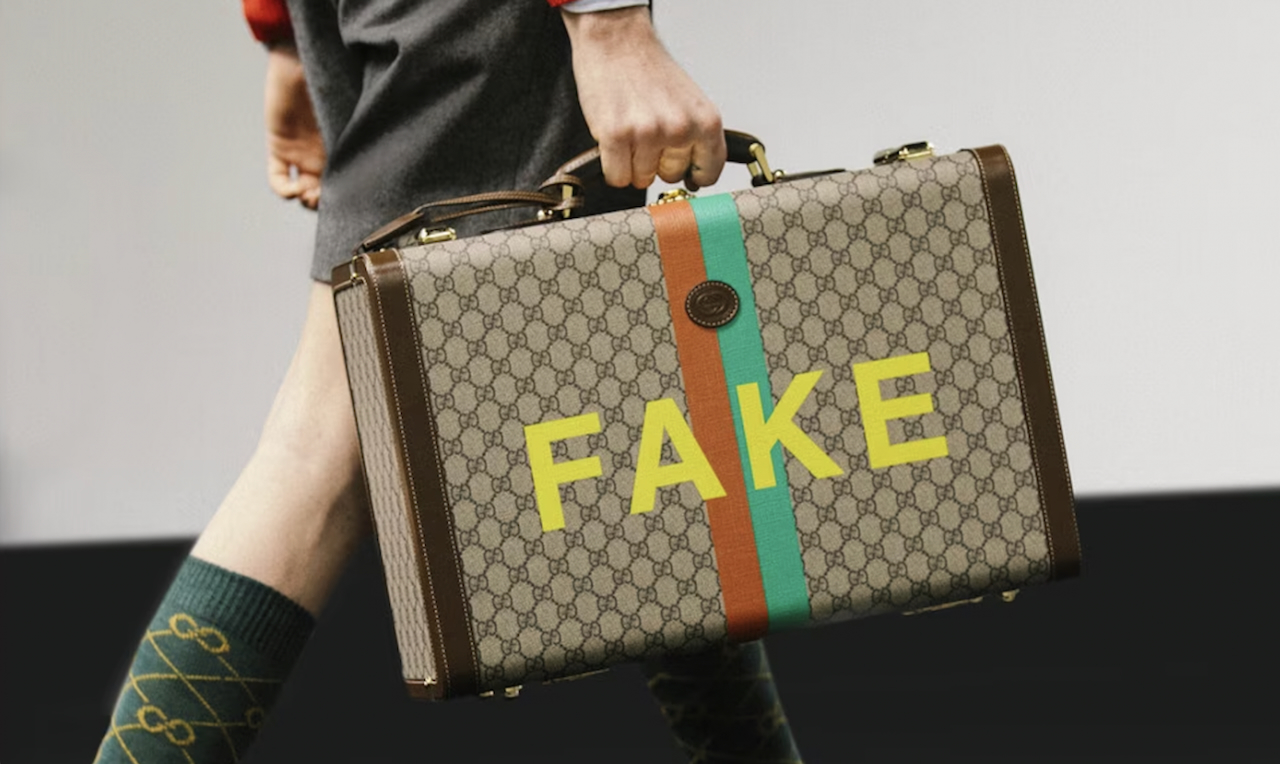
Luxury created the conditions for its own imitation. Now it would rather blame the customer.

For years, the luxury industry has been fighting a heroic battle against dupes. Lawyers send letters. Brands demand stronger enforcement. Fashion executives lament the erosion of craftsmanship, intellectual property and creativity. China is blamed. TikTok is blamed. Fast fashion is blamed. Consumers, apparently suffering from a mysterious collapse in moral judgment, are blamed too.

GUCCI decided that if you can’t make the fakes disappear, you might as well put FAKE on the real thing. A rather elegant way for a luxury brand to face its counterfeit problem: with humor instead of indignation.

GUCCI decided that if you can’t make the fakes disappear, you might as well put FAKE on the real thing. A rather elegant way for a luxury brand to face its counterfeit problem: with humor instead of indignation.

Almost everyone gets a turn.

Except, curiously, the luxury industry itself.

Perhaps it is time to consider a less comfortable possibility: the dupe is not an attack on the modern luxury business. It is one of its products.

Luxury spent decades increasing prices, expanding production, standardizing design, industrializing desire and teaching consumers to recognize a product from twenty meters away. Then it seemed surprised when somebody figured out how to make something that looked remarkably similar for $79.

The dupe wasn't an accident.

It was inevitable.

First, Make Desire Unaffordable

There is nothing particularly strange about a rare object being expensive. A hand-built automobile is expensive. A unique piece of jewelry can be expensive. A couture dress requiring hundreds of hours of skilled labor should be expensive.

The interesting question begins when an industrially produced fashion accessory costs several thousand dollars.

Of course, material value has never been the point of luxury. We understand this. A handbag is not priced by adding leather, thread, zipper and labor and then applying a modest retail margin. Luxury sells design, heritage, craftsmanship, scarcity, status, fantasy, cultural participation and, occasionally, a rather beautiful box.

Fair enough.

But over the past two decades, something changed. Prices began rising much faster than the underlying objects seemed to improve.

The explanation is often inflation, materials, craftsmanship, rents, wages and currency fluctuations. All real things. But another force has been prowling around the luxury garden: financialization.

Luxury houses increasingly belong to enormous publicly traded groups, investment structures and private-equity portfolios. They are not merely expected to make beautiful things. They are expected to grow.

Every year.

Preferably faster than last year.

The Germans have a wonderfully agricultural nickname for aggressive private-equity investors: Heuschrecken. Locusts. It is unfair to apply the term indiscriminately, but the image is irresistible: arrive, extract value, improve margins, demand growth, move on.

The romantic maison and the spreadsheet have become roommates.

The $20,000 Wardrobe Problem

Here is where the industry's argument becomes slightly absurd.

Fashion tells women that clothes are self-expression. Develop your style. Experiment. Change. Mix references. Try another silhouette. Wear color. Wear black. Discover a new designer. Reinvent yourself. Don't repeat the same look forever.

Wonderful advice.

Then luxury presents the bill.

A CHANEL bag can cost $10,000. PRADA Shoes can cost $1,700. A SAINT LAURENT jacket can cost $8,500. Add sunglasses, jewelry, watches, knitwear, something for summer, something for winter, something understated, something ridiculous, and perhaps a tiny evening bag incapable of carrying an evening.

Apparently, authenticity requires quite a budget.

And one item is not enough, because fashion's entire cultural proposition depends upon change.

A genuinely varied luxury wardrobe containing different designers, colors, moods, seasons, and narratives can easily cost as much as a new car.

And then fashion changes again.

This creates a peculiar form of consumer arrogance in reverse. The industry essentially says: We have decided that this fashionable object is worth several thousand dollars. If you appreciate the design but cannot or will not pay that amount, you should simply abstain.

Consumers looked at that proposition and invented another answer.

No.

China Didn't Invent the Incentive

China makes an easy villain because China became extraordinarily good at manufacturing things. But blaming China for dupes is a little like blaming photocopiers for paperwork.

Factories manufacture what markets demand.

For decades, Western brands deliberately built enormous supply chains across Asia because those supply chains could produce sophisticated products quickly, reliably, and cheaply. Manufacturing knowledge spread. Machinery improved. Materials became accessible. Product development accelerated. Global logistics became astonishingly efficient.

Meanwhile, Instagram, TikTok, influencers and luxury brands themselves distributed high-resolution images of desirable products across the planet within seconds.

Luxury effectively created the world's most efficient desire-distribution system and connected it to the world's most efficient manufacturing system.

What exactly did everyone expect to happen?

When the Story Costs More Than the Thing

The luxury industry is correct about one important point: a genuine product and a dupe are not the same thing. But that is precisely why the dupe is interesting. It acts as a crude little laboratory experiment.

Take away the boutique. Take away the heritage. Take away the celebrity campaign, the fashion show, the packaging, the logo mythology, the scarcity narrative and the carefully cultivated social meaning.

What remains?

Sometimes quite a lot. Sometimes alarmingly little.

Dupes aren't stealing luxury's value so much as measuring how much of that value existed in the narrative in the first place. That doesn't make copying admirable. It makes copying revealing.

Luxury Standardized Itself

There is another problem, and perhaps a more dangerous one. Luxury became easier to imitate because luxury itself became more standardized.

The industry consolidated. Conglomerates grew. Consultants circulated. Executives moved between houses. The same celebrities appeared in campaigns. The same global cities received the same gleaming stores. The same airports became luxury shopping malls with attached departure gates.

Design still matters enormously, and extraordinary creative work still emerges. But the commercial machinery surrounding it has become remarkably uniform.

When every brand needs recognizable icons, quarterly growth, global scalability, social-media visibility, and products capable of becoming bestsellers across continents, differentiation begins fighting economics.

The paradox is delicious.

Luxury needs to be distinctive enough to desire and standardized enough to scale.

The dupe merely finishes the equation.

The Difference Between a Dupe and a Fake

There is also a distinction worth defending.

A counterfeit pretends to be something it isn't. It uses another company's trademark and sells deception.

A dupe usually does something more slippery. It says, essentially: You know that shape everybody wants? Here is our version.

Fashion has always worked this way to some degree. Ideas migrate from couture to ready-to-wear, from runway to department store, from subculture to luxury, from luxury back to the street. Designers quote history, vintage clothing, uniforms, workwear, indigenous textiles, punk, sportswear, and one another.

The industry prefers to call this inspiration when it travels upward.

When it travels downward, the vocabulary becomes less charitable.

Consumers Aren't Stupid

This may be the largest mistake luxury can make.

Consumers understand the game better than the industry sometimes assumes.

They know a $4,000 handbag does not contain $4,000 worth of leather. They know the campaign starring a famous actress cost money. They know the boutique on Avenue Montaigne costs money. They know they are buying participation in a cultural narrative.

Many are perfectly happy to do so.

The problem begins when the gap between price and perceived value becomes too large.

At that point, the consumer doesn't necessarily stop wanting the design.

She stops accepting the equation.

The dupe appears in that gap.

Perhaps Luxury Should Become Luxurious Again

The solution to dupes probably isn't to lecture consumers more vigorously.

It may be to make the original harder to substitute.

True scarcity is difficult to dupe. Exceptional craftsmanship is difficult to dupe. Extraordinary materials are difficult to dupe. Personal service is difficult to dupe. Provenance is difficult to dupe. A genuinely original idea remains difficult to dupe, at least until Tuesday.

Luxury has enormous territory available beyond logos and pricing power.

Make things worth repairing. Make things people keep for twenty years. Make strange things. Make difficult things. Make products whose value becomes more apparent when you hold them rather than less.

Perhaps even make fewer of them.

That would require accepting something modern capitalism finds surprisingly uncomfortable: not everything has to scale indefinitely.

The Copy Has a Message for the Original

The dupe is usually treated as an inferior object standing outside the gates of luxury, trying to sneak in.

Perhaps we have the relationship backward. It is feedback.

It tells the industry where consumers still perceive design value but no longer perceive corresponding monetary value. It reveals which products are genuinely distinctive and which depend primarily on recognition. It exposes the widening distance between what something costs to make, what it costs to buy and what people believe it is worth.

For years, luxury has asked consumers to buy authenticity.

Consumers have started asking luxury to prove it.

And that may be the most authentic thing to happen to the industry in years.